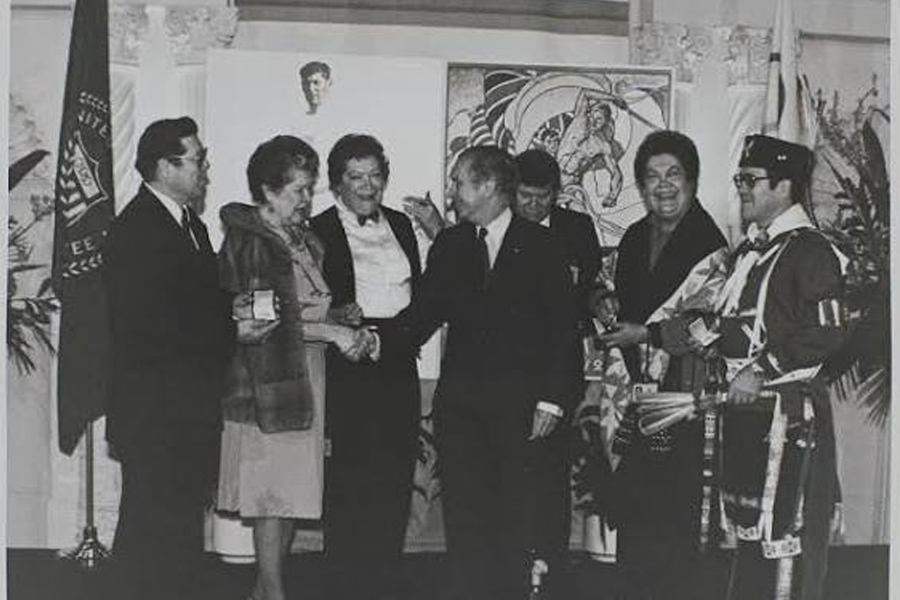
The life of writer, philanthropist, and Indigenous cultural advocate Dagmar Thorpe spans generations of Native history. Sac & Fox Nation member with Kickapoo, Menominee, and Potawatomi ancestry. She inherited a family history of athletic success, military service, political battle, cultural rebirth, and endurance as the granddaughter of Jim Thorpe and Grace Thorpe.
Since Dagmar Thorpe’s story isn’t just a celebrity biography, I’m intrigued. Finding meaning in identity throughout time is the story. She spent part of her upbringing in Japan and Pearl River, New York, a white suburb. She grew more interested in Native affairs, philanthropy, language preservation, and traditional lifeways as an adult.
Childhood in Japan and New York
Dagmar Thorpe was born in Japan in either 1946 or 1947. Her mother, Grace Frances Thorpe, was serving with the Women’s Army Corps during the postwar occupation. Grace had worked in New Guinea and the Philippines and later served in Japan at General Douglas MacArthur’s headquarters in Tokyo.
Lieutenant Fred W. Seely fathered Dagmar. June 1946 saw Grace and Fred marry in Japan. The family returned to the US after their 1950 divorce. Early on, Dagmar and her brother Paul were tied to the Seely surname, but their heritage was Thorpe.
Family moved to Pearl River, NY. Dagmar was raised in a community where Native identity was not always public. Her history was acknowledged in the family, but she was not raised around the rites, languages, and political movements that would influence her work.
That distance may have shaped her adulthood. Identity is sometimes like a seed in a foreign soil. Silence may last years until it finds growth conditions. Education, family, and Native activism created those conditions for Dagmar.
Her Mother Grace Thorpe
Grace Thorpe was the youngest child of Jim Thorpe and Iva Margaret Miller Thorpe. Born on December 10, 1921, she lived through several distinct chapters of American and Native history.
During World War II, Grace served as a corporal in the Women’s Army Corps. Her service took her to New Guinea, the Philippines, and Japan, and she received a Bronze Star. Her work at MacArthur’s headquarters placed her close to the political and military administration of occupied Japan.
Grace became a major Native rights campaigner after returning to the US and raising her children. She worked in public relations during the 1969–1971 Alcatraz occupation, when Indians of All Tribes raised awareness of Indigenous sovereignty and government policy.
Grace also worked with the National Congress of American Indians on economic development. She served as a tribal judge and health commissioner for the Sac and Fox Nation. Her activism extended to environmental protection, particularly opposition to nuclear waste being placed on tribal lands.
Her battle to restore her father Jim Thorpe’s Olympic records and medals was tenacious. Although his athletic exploits were recognised worldwide, his family felt wronged by the treatment of his Olympic legacy. Grace pressed the matter for years.
She died on April 1, 2008. Her influence continued through her children, grandchildren, and the archival materials later preserved by Dagmar and Dagmar’s daughter.
Jim Thorpe and the Family Athletic Legacy
Dagmar’s grandfather was James Francis Thorpe, better known as Jim Thorpe. Born in 1887, he was a member of the Sac and Fox Nation and became one of the most versatile athletes in modern history.
He won pentathlon and decathlon gold at the 1912 Olympics. He was a symbol of athletic greatness after playing professional football and baseball. The Olympic medals were withdrawn after suspicions regarding his amateur status, but reinstated decades later.
Jim Thorpe’s parents were Hiram Thorpe and Charlotte Vieux. His family lineage included Sac and Fox connections that Dagmar later explored through genealogical research. She compiled an annotated genealogy and bibliography concerning Jim Thorpe’s ancestors, covering family history reaching back from 1700 to 1887.
The Carlisle Indian School introduced Jim to Iva Margaret Miller, his first wife. They married in 1913 and had several children, including Grace. Iva later remarried Harry Davies. Through this branch of the family, Dagmar acquired not only a famous surname but also a complex record of Native education, government policy, athletics, and cultural survival.
Dagmar Thorpe’s Brother Paul
Dagmar’s younger brother was Paul Thorpe, sometimes identified as Paul “Thorpe” Seely. He was born in Japan in 1948 and died in a car accident in 1964, when he was a teenager.
The death of Paul affected Grace severely. The loss was a big family emotional turning point. It altered Grace’s priorities and direction. Family traumas frequently leave hidden scars, yet they can influence choices for decades.
Education and Cultural Work
Dagmar studied social psychology at Goddard College, where she earned a bachelor’s degree. She later received a master of arts degree in Indigenous studies from D Q University in Davis, California, one of the earliest tribal colleges in the United States.
Her references mention extra academic study or a doctoral context. Historic Smithsonian materials also use “Dr.Dagmar Seely.” Her academic interests were Indigenous history, identity, and community development, but her public record is inconsistent.
Her art frequently returns to language. For Dagmar, language is more than communication. It conveys memory, morals, humour, law, ceremonial, and a community’s worldview. She has helped Sac and Fox language revitalisation and Thakiwa language preservation organisations.
Work in Indigenous Philanthropy
Dagmar became a major figure in Native philanthropy. She helped found and direct the Seventh Generation Fund, an organization that supports Indigenous communities through grants, training, fiscal sponsorship, and leadership development.
The fund emerged from 1960s and 1970s Native advocacy and became independent in the 1980s. It has supported cultural programs, environmental protection, Native women’s efforts, language projects, youth leadership, and sovereignty campaigns.
Dagmar’s involvement reflected her belief that philanthropy should place resources in the hands of communities themselves. Instead of imposing outside solutions, Indigenous grantmaking can help local people define their own needs and protect their own knowledge.
She helped LifeWay fundraise and develop programs. In the early 1990s, she worked with the Ira Hiti Foundation, later the Foundation for Deep Ecology, to revive Native customs and traditions. She was interim director of the Fund of the Four Directions, which supported nonprofits preserving American Indian traditions.
Her 1996 book, People of the Seventh Fire: Returning Lifeways of Native America, brought together Indigenous perspectives on cultural resurgence, language, and identity. The title evokes the idea of a cultural return, in which communities recover values and lifeways that have been threatened but never fully extinguished.
Writing and Family Archives
Dagmar has written about tribal justice, genealogy, cultural renewal, and Native identity. In 1976, she prepared a position paper concerning tribal court appellate processes and the creation of a Board of Native American Justice.
Her genealogy research on Jim Thorpe’s forebears preserved facts from family records. She makes genealogy more than a family tree. A map of belonging shows how names, places, marriages, migrations, and tribal relationships build a living inheritance.
She and her daughter Tena Malotte gave Grace Thorpe’s papers and materials to the Smithsonian’s National Museum of the American Indian Archives Center in 2015. Grace’s military, activism, and family history photos, documents, and records are in the collection.
Dagmar’s Daughter Tena Malotte
Tena Malotte has continued the family’s interest in preserving history. Her collaboration with Dagmar in donating Grace’s papers helped make an important collection available for future study and public understanding.
Tena is also continuing the family tradition. Grace maintained contact with Tena, Aspen, and Huna, her great-grandchildren. These ties transformed family history from photos and papers into daily recollection and intergenerational instruction.
A Family Connected by Service
The Thorpes served in many ways. Jim Thorpe symbolised athletic greatness globally. After serving in the military, Grace advocated Native rights, tribal health, and environmental justice. Dagmar established philanthropies and revitalised culture. Tena protected the family archive.
Their paths were different, but they valued dignity and consistency. Each generation confronted unique challenges. Jim wanted sports recognition and racial discrimination. Military duty, political advocacy, and native autonomy were Grace’s goals. Dagmar worked to sustain cultural action from heritage.
Frequently Asked Questions
Who is Dagmar Thorpe?
Dagmar Thorpe is a Sac and Fox Nation member, writer, philanthropist, and advocate for Indigenous cultural revitalization. She is best known for her work in Native philanthropy, language preservation, traditional lifeways, and family history.
Is Dagmar Thorpe related to Jim Thorpe?
Yes. Dagmar Thorpe is Jim Thorpe’s granddaughter. Her mother was Grace Frances Thorpe, one of Jim Thorpe’s daughters with Iva Margaret Miller Thorpe.
Who was Dagmar Thorpe’s mother?
Her mother was Grace Frances Thorpe, a decorated World War II veteran and longtime Native rights activist. Grace worked on issues involving tribal sovereignty, economic development, health, environmental protection, and the restoration of Jim Thorpe’s Olympic honors.
Where was Dagmar Thorpe born?
Dagmar was born in Japan in 1946 or 1947 while her mother was serving with the Women’s Army Corps and working at General MacArthur’s headquarters during the postwar occupation.
What organizations did Dagmar Thorpe work with?
She helped found and lead the Seventh Generation Fund and also worked with LifeWay, the Fund of the Four Directions, and the Ira Hiti Foundation, later known as the Foundation for Deep Ecology.
What book did Dagmar Thorpe write?
She authored or edited People of the Seventh Fire: Returning Lifeways of Native America, published in 1996. The book focuses on Indigenous cultural renewal, traditional knowledge, language, and identity.
Who was Dagmar Thorpe’s daughter?
Her daughter is Tena Malotte. Dagmar and Tena worked together to donate Grace Thorpe’s papers to the Smithsonian National Museum of the American Indian Archives Center in 2015.
Why is language preservation important to Dagmar Thorpe?
Dagmar has emphasized that Indigenous languages preserve cultural knowledge, values, history, ceremony, and community identity. Language revitalization is therefore a central part of cultural survival and self determination.